
By Andrew Duffin, Edited by Isaac Gavaghan
Part I: The High-Rise
In modern Britain, local politicians are all too often dismissed as middle managers with rosettes, Buggins’-turn-type figures who perennially overpromise yet underdeliver. But the Novocastrian council leader T. Dan Smith remains an exception. To some, he embodied the nadir of local government in the 1960s: an oleaginous Jaguar-driving council boss, in the pocket of right-wing architects and complicit in the wanton destruction of our historic cities. To others, he was amongst the most formidable figures municipal government. His long-serving successor, Jeremy Beecham, had no qualms in ranking him alongside the titans of Joseph Chamberlain and Herbert Morrison. So, should Smith be remembered as Newcastle’s greatest champion or its most ignominious vandal?
Thomas Dan Smith was born in 1915 to a mining family and would leave education age 14. Struggling for employment during the slump of the 1930s, he trained as a painter. In 1947, he founded the successful ‘Smith’s Decorators’. Within 10 years, Smith would own 7 decorating companies across the north. Beginning in 1960, Smith became involved with various public relations (PR) companies. He foresaw the crucial importance of media management to politicians, trailblazing the spin-doctor age. Yet the blurred lines between his political career and business interests would lead to his downfall.
Today, Smith would be regarded as coming from the ‘hard left’ of the Labour Party: both of his parents were Communists, and Smith himself was expelled from both the Independent Labour Party and the Revolutionary Communist Party during the early 1940s whilst campaigning for pacifism. By 1948, Smith had come in from the cold and joined the Labour Party. He ran for election as city councillor in 1950 for the Walker ward of Newcastle, while sycophantically claiming that he had been a life-long party member. This attempt to recast his political past, foreshadowed the smoke and mirrors that would come to characterise Smith throughout his career.
Smith’s path to power began when Labour took control of the incongruously Tory-dominated (under the guise of ‘Progressive’) Newcastle City Council in 1958. Smith emerged from the victory as chairman of the Housing Committee. During the election campaign Smith recognised that “the one single issue that seems to excite the enthusiasms of the electorate is housing”. It was to be an arduous task with housing conditions amongst the lowest in the country and 16,500 families waiting to be rehoused. Contrary to the mythology Smith, did not initially adopt a tabula rasa approach to redevelopment. In 1958, he pleaded with the Tory Housing Minister Sir Keith Joseph, to support his ‘Operation Revitalise’ scheme to renovate hundreds of terraced houses, but to no avail. Therefore, in line with the times, high-rise towers were favoured by his administration.
High-rise towers did have their advantages, enabling Geordies to remain close to their livelihoods rather than being exiled away to overspill developments like Killingworth. The high-rises themselves were often ‘System Built’ enabling them to be erected quickly, as prefabricated panels could be slotted together on site. However, inadequate construction led to: dampness, mould and vermin. Though Smith maintained that even the worst of the flats that he put up were an improvement of the previous terraced slums; the blocks would still condemn his legacy to many.
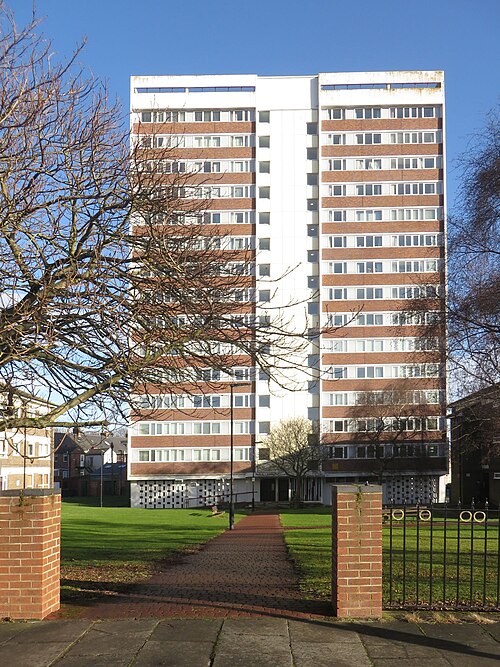
The drive for more housing would result in Smith’s first scandal - the Crudens affair. Crudens was a Scottish building firm which employed one of Smith’s PR firms. Whilst this was occurring, the city council found itself in need of 3 blocks of flats (including one in Spital Tounges) and by a remarkable stroke of luck Crudens was selected by the Housing Committee. Though Smith had been absent from all the relevant committee meetings, sufficient eyebrows were raised. The housing minister – Sir Keith Joseph – rejected the plan but on grounds of cost as to avoid allegations of partisanship. Ironically, the scheme that was eventually built cost more than Crudens’ proposal. The cherry on the cake was that he ended up living on the 14th floor of the Spital Tongues tower block – thus Smith’s ultimate retribution was having to live in it.
But Smith’s legacy was not confined to housing, he understood that higher education would attract talent and investment to Newcastle. In 1963, T. Dan Smith used compulsory purchase to allow King’s College to expand its campus within the city centre. Preventing the academics from fleeing to the leafy suburbs of Gosforth. Later that year, King’s College became independent of Durham University, forming Newcastle University. Smith also promoted the formation of Newcastle Polytechnic, a forerunner of Northumbria University. To aid access to these institutions, he pooled together funding from local councils to enable a £14 million expansion of Newcastle Airport. In keeping with his goal of improving Newcastle’s image, Smith brought together 18 riverine agencies clean up the Tyne and by the 1970s it was clean enough for salmon to return. Smith also had plans for the redevelopment of the home of Newcastle United, St James’ Park, into a multi-sports entertainment complex. Yet he ultimately failed to convince the conservatively minded NUFC directors.
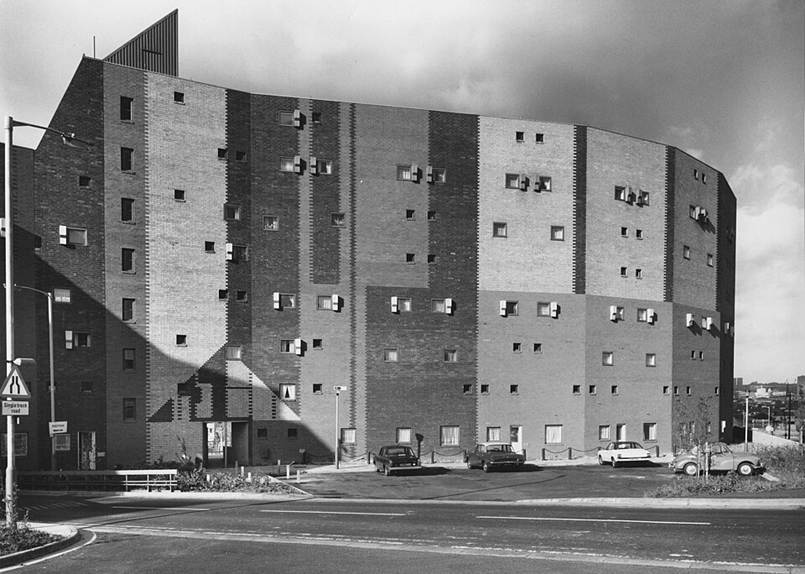
One accomplishment often apocryphally attributed to Smith, was the Tyne and Wear Metro light rail service. Although the idea was first mooted under Smith’s administration, he was long removed from local government by time of the 1973 Tyneside Metropolitan Railway Act. Smith also attempted to take credit for the building of the Byker Wall - designed by Ralph Erskine. Through its sensitive use of Scandinavian Modernism, it offered a successful alternative to typical tower blocks, once championed by Smith. Despite sharing similar ideals with Erskine such as maintaining community bonds, Smith's credit is made rather dubious by the fact Byker Wall was commissioned by Arthur Grey’s Conservative-led administration in 1969.
Despite these successes, Smith remained committed to the North East and he would never hold significant national office. This was not entirely for lack of opportunity. In 1964, he reckoned that Harold Wilson would appoint him as ‘Minister for Regional Government’ as part of an attempt to shake up Whitehall. Yet this never materialised, allegedly because the security services briefed Wilson about emerging corruption allegations. Smith later declined a consolatory job offer from George Brown.
Smith preferred the connected atmosphere of local government, a preference crystallised by his work on the Redcliffe-Maud Report from 1966-69. The report suggested that England should be divided into eight devolved provinces. As Smith argued without effective regional government, large services would be run by anonymous administrators “remote from people”. Time has proven him correct as currently demonstrated by today’s myriads of unaccountable transport bodies and the reckless water industry. Smith would later go further to suggest that the House of Lords should be abolished and replaced by politicians chosen by the provinces.
Yet Smith is remembered not for his constitutional programme but instead his wholesale redevelopment of Newcastle city centre, which became synonymous with the phrase ‘Brasilia of the North’, but this remains contentious. From the start, Smith wanted to attract the top architects of his day to Newcastle, Basil Spence was commissioned to design the new, brutalist City Library and there were even plans to commission Le Corbusier! Though I imagine that the sighted are thankful that there never was a Geordie Plan Voisin.
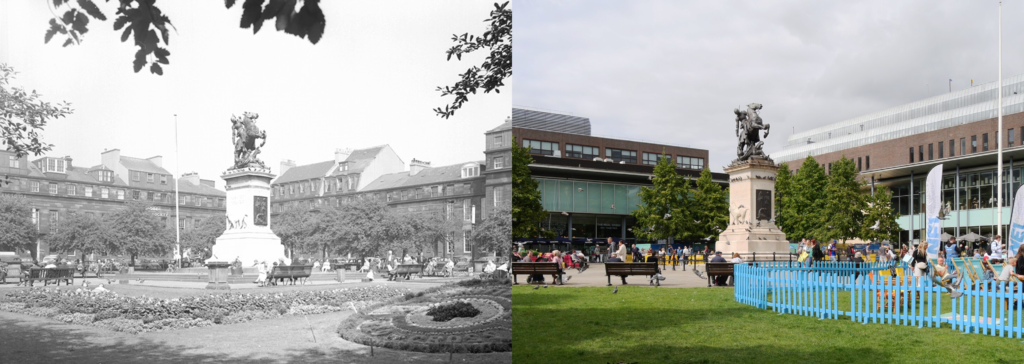
The greatest charges of architectural vandalism which can be levied against Smith: concern the demolition of old Eldon Square and the Royal Arcade, both designed by John Dobson. Yet in keeping with the rest of Smith’s legacy, each charge has caveats and qualifications. With Eldon Square, Smith was alleged to have only sanctioned the redevelopment on the assumption that the distinguished Arne Jacobsen (architect of St Catherine’s College Oxford) would design its replacement which Jacobsen didn’t. Whereas with the Royal Arcade, it was dismantled – to make room for the Swan House roundabout. With the intention of rebuilding the arcade, in a more suitable location. However, the succeeding administration decided not to, apocryphally attributed to the chalk markings washing off the stones. A plaster interior replica was later reconstructed inside Swan house, this ersatz copy soldiered on until 2002 where the majority of it was demolished. The remaining section somewhat survives as an interior for the ‘Blue Peacock’ restaurant.
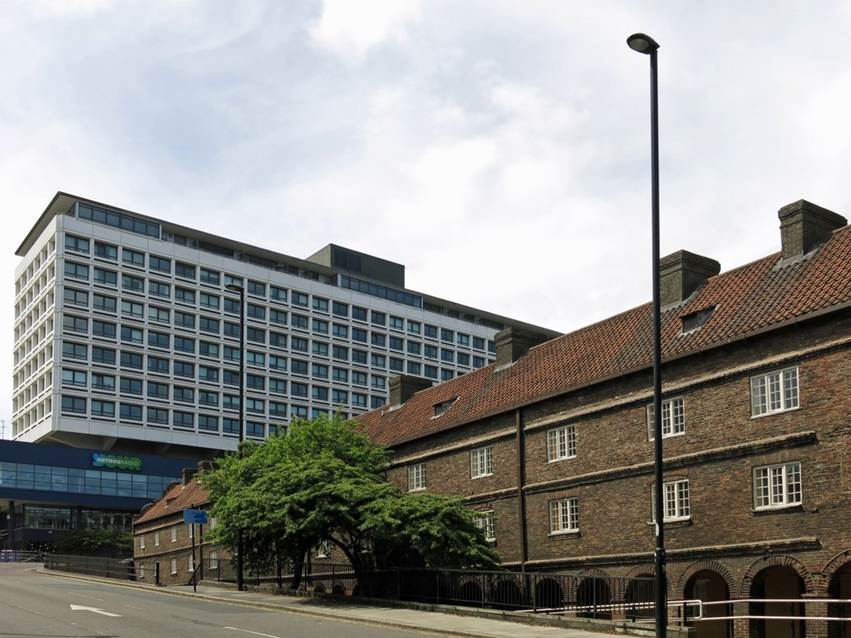
For all of his misplaced architectural enthusiasm, Smith was not without an eye for preservation. T. Dan Smith saved the 1681 Holy Jesus Hospital, at the expense of it being rammed square-up against a concrete underpass and shaded by the canopy of Swan House. One could suggest that the building would have preferred martyrdom. Smith also provided funds for the restoration of the medieval city walls, and he prevented Midland Bank from erecting a modernist eyesore in the centre of the neoclassical Grey Street.
Read here part II, where we take a look at what went wrong on the the road to utopia.
Please note: the views expressed in this article do not necessarily reflect those of the wider Labour club.
Background Image Credit: T Dan Smith Archive, T Dan Smith at Cruddas Park, c. 1960s-1970s. CC BY-NC. Via AmberSide Collection
Sources and Further Reading


